

Getting it Right, Together: Reflections from states and applicants regarding SteadyIQ’s verification solutions

By:
Chloe Green, Director, National Policy & Strategic Partnerships
The SteadyIQ team was honored to host a webinar with APHSA on October 27 that tackled what it takes to build resilient agencies and the role that consent-based verification (CBV) plays in that effort. Our panelists were at all different phases in their journey with SteadyIQ: from getting ready to launch, to piloting, to going statewide, to years of experience. They shared how CBV fits into the larger picture of their work to improve accuracy. I’d encourage you to take an hour (or less if you speed it up!) to watch the full recording here.
The balance states are always navigating
For as long as I’ve worked on SNAP, and for long before that, states have had to balance accuracy and access in every decision that impacts the program, whether it’s taking up a state option, modernizing an eligibility system, or adjusting an application. I think of it kind of like a seesaw. Since H.R. 1, there’s been so much more pressure on the accuracy side that the access side can go flying. With immense new costs, states have no choice but to act, and because income has always been the leading driver of payment errors, it’s no surprise that 82% of states responding to APHSA’s survey this summer said they were implementing or considering enhanced income verification, like CBV.
Commissioner Duke Storen from Virginia’s Department of Social Services took my seesaw analogy one step further, insisting there’s actually another seat for efficiency. Virginia is looking for solutions that drive access, accuracy, and efficiency all at once, and is working with SteadyIQ on both CBV and intelligent document processing as ways to do just that. Greg Brockmeier from Nebraska DHHS shared what happens when efficiency gets left out of the equation. Like many states, Nebraska has been relying less on self-attestation, and while the added verification has improved accuracy, it has also slowed things down for staff and clients. Nebraska sees CBV as a way to bring efficiency back into balance.
Our shared goal of feeding families
With all the pressure the programs are currently facing, it could be easy to lose sight of who’s on the access side of the seesaw - but throughout the webinar our panelists continued to come back to the frontline worker and the participant. Zee Zaidoff, a lived experience consultant in rural Hawai’i, grounded us from the beginning with a reminder that people applying for SNAP are trying to feed their families, and “we want to do it right.” For Zee as a self-employed person with multiple jobs, that has meant figuring out how to verify a W-2 and multiple 1099s, taking screenshots, paying 18 cents a page to print, and mailing an envelope that has to go to another island before it reaches an office 17 miles away. Doing it right shouldn’t be that hard, and SteadyIQ is working to remove barriers.
Why CBV, and why now?
Traditional income databases have been around for a long time and work well, but they have limits on what they can show and can be costly for agencies. CBV takes a different approach - inviting applicants to share their income directly from the source so it’s verified upon receipt, and puts together W-2 jobs, gig work, and financial institution information such as when people are paid through apps like Venmo or PayPal into one report that can be used across programs.
As everyone has been talking about, H.R. 1 has been a seismic shift in human services programs, demanding that agencies take a hard look at what they can do differently. But states have had to quickly adapt before. The pandemic is what pushed Missouri to become the first state in the country to try CBV for SNAP in 2021. Melissa Wolf, formerly the Deputy Director of Missouri DSS and now Director, Government Strategy and Operations at SteadyIQ, remembered telling her team, “I’m not sure it’s going to work,” and then, “It worked better than I thought it would.” Missouri saw SNAP determinations four to five days faster on average, a win for families AND for the caseworker who, as Melissa put it, “just wants to help.”
Building and maintaining partnerships through trust
If everyone wants to get it right, what gets us there is trust - built at every level. With applicants, it starts with being clear about what they’re consenting to. There’s still a lot of talk about fraud, but the vast majority of people are honest and just need help feeding their families. Greg sees CBV helping those families share the right information, so “the focus on the bad actors can stay there where it should be.” With agency caseworkers, Iva-Starr Cain from Hawai’i DHS shared that seeing staff feedback turn into real changes, like texting the link and uploading paystubs directly, built trust, and Zee saw at the trainings that workers “want to do things right the exact same way” her community does. With community partners, it’s the community center or food basket people already know, which Zee, Melissa, and Iva all named as essential.
And with vendors, as Commissioner Storen put it, “you’re buying tech and you’re also buying people.” He’s looking for partners focused on solving a specific problem really well, with staff who have lived experience in these programs, both accessing services and working as caseworkers, because “that perspective makes a big difference.” That’s exactly what purpose-built means to us at SteadyIQ, and it meant a lot to hear him say what he likes about SteadyIQ is that we “lead with a yes” instead of a change order. Hear Commissioner Storen share in his own words why he likes working with SteadyIQ.
Any change takes time, communication, and real on-the-ground effort. Melissa wished she’d communicated more with participants, workers, and community partners from the start. Things won’t always go perfectly. But with a foundation of trust, and remembering that people just want to get it right and we’re all working to feed families, we can work through it together. That’s the kind of partnership we’re committed to at SteadyIQ.
If you want to talk more about income verification or what it’s been like going from an association to the vendor side, reach out and let’s catch up!
----------
Additional Insight:
WATCH THE WEBINAR: Building Resilient Agencies: Why Purpose-Built Verification is the Foundation for Future Success
Other articles
See more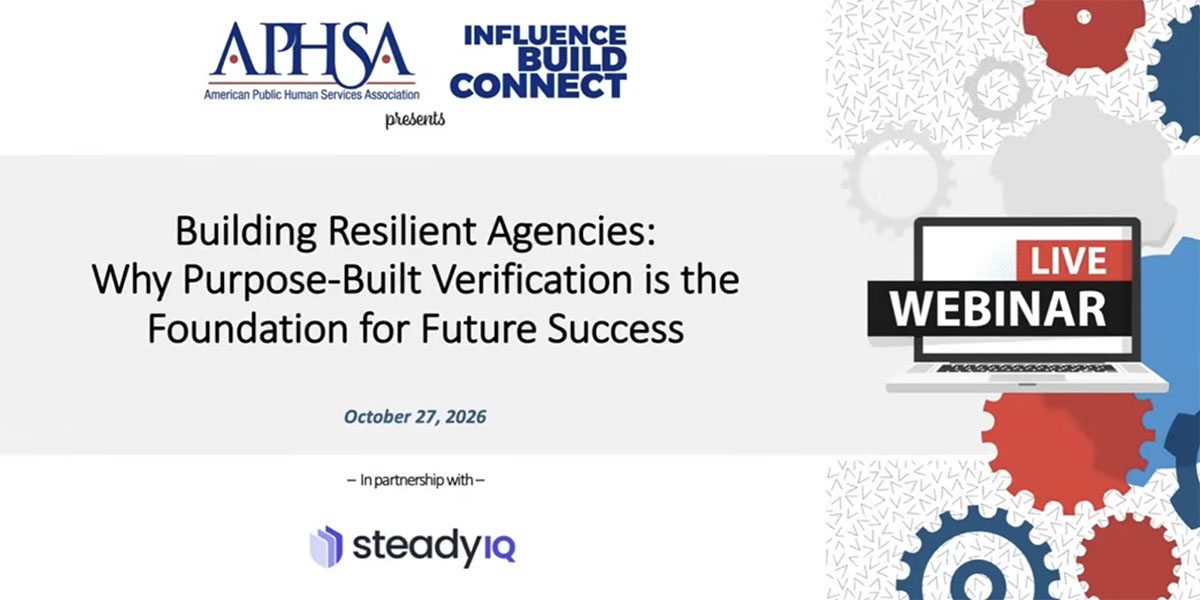
Webinar
Building Resilient Agencies: Why Purpose-Built Verification is the Foundation for Future Success.
SteadyIQ is so proud to have co-hosted a webinar with APHSA to focus on helping agencies prepare for and focus on future success. We are so appreciative of our panel of human services leaders from Virginia, Nebraska, and Hawai'i and our lived experience consultant who shared their insight regarding consent-based verification (CBV), the role it plays in creating a resilient agency, and their experience working with SteadyIQ. Check out the webinar to learn more about how SteadyIQ's purpose-built verification solutions help agencies move the needle regarding access, accuracy, and timeliness.


Articles
Leveraging Verification to Create the Future of Benefits Eligibility: Why Purpose-Built Verification Is the Foundation for Modernizing Human Services Administration
We are in a unique moment in history. The mandated, expanded H.R. 1 requirements are not only a shift in policy, but a stress test for the entire public benefit infrastructure.
Streamline your eligibility verification with SteadyIQ.
Book a demo to see how our Verification Hub can simplify your verification workflows, reduce costs, and improve accuracy.